Why Good News Days Are So Exhausting for Caregivers
Quick Answer: Good news days flatten caregivers because vigilance is what was holding you upright, and good news removes it abruptly. The alertness that carried you through weeks of uncertainty was hormonally supported, and when the threat resolves, that support withdraws faster than your reserves recover - so the exhaustion you had been deferring arrives all at once. It is a documented pattern, not ingratitude, and it usually resolves in 24 to 72 hours. Planning for a flat day after good news works far better than being ambushed by one.
The results were fine. The doctor was pleased. Everyone else was relieved and moved on with the afternoon.
You got home, sat down, and could not get back up. And somewhere underneath the exhaustion was a quiet, uncomfortable question about what is wrong with you that good news would do this.

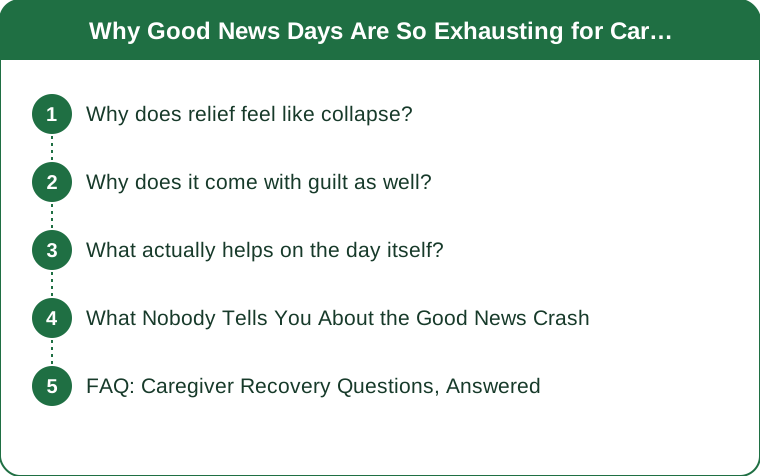
Why does relief feel like collapse?
Because the vigilance was structural, and you just removed the structure.
In the run-up to a scan, an appointment, or a decision, you are operating in a sustained state of alertness. That state is physiologically expensive and it is also functionally useful - elevated stress hormones sharpen focus, suppress your perception of fatigue, and let you run on inadequate sleep without registering how depleted you are.
When the threat resolves, that hormonal support withdraws over roughly a day. Everything it was masking becomes available to you at once: the sleep debt, the muscular tension, the emotional backlog, the meals you did not really eat.
This is the same mechanism behind the crash people report on the first day of a holiday, or the headache that arrives after a deadline rather than before it. In migraine research it is well described as a let-down effect - attacks cluster in the period following stress rather than during it.
For caregivers there is an additional layer. Vigilance is not just a mood, it is a role. Being the person who watches, tracks, and anticipates gives the day a shape. When good news lifts that requirement, even temporarily, some people describe a strange disorientation - not sadness exactly, but a sense of the floor moving. The thing you were braced against is not there, and bracing is what you had been standing on.
So the flatness after good news is not a failure of gratitude. It is what happens when the alarm finally switches off and you find out what it was drowning out.
Why does it come with guilt as well?
Because the emotional response does not match what you think the situation calls for, and caregivers tend to be hard on themselves about that mismatch.
There is often a specific set of feelings that arrive together on a good news day, and they can look contradictory:
Relief that does not feel like relief. You know the news is good. You cannot access the feeling. This is very common and it is usually just depletion - emotion takes energy, and there is none left.
Anger with no clear target. Sometimes surfacing at exactly the moment it becomes safe to feel it. Anger during a crisis is inconvenient and gets suppressed; it does not vanish, it waits.
Grief that seems out of place. Good news often means a return to ordinary life, which means noticing what the past weeks or months cost - plans dropped, work missed, a version of your own life that has been on hold. That noticing can only happen once the emergency ends.
Fear that the good news is temporary. For many caregiving situations it genuinely is one good result in an ongoing condition, and the relief comes with the knowledge that you will be here again. That is realistic rather than pessimistic, and it does complicate the celebration.
And guilt about all of the above. Which is the least useful of them and the most reliably present.
None of this means you are ungrateful or that you did not want the good outcome. It means that a sustained caregiving period generates a backlog of feeling that has been actively postponed, and the first safe moment is when the invoice arrives.
This is general information, not medical advice. If low mood, exhaustion, or anxiety persist for more than a couple of weeks, that is worth raising with a doctor.

What actually helps on the day itself?
Treat it as a recovery day rather than a celebration day. Five practical things.
Plan for it in advance. If you know a result is coming on Thursday, protect Thursday evening and Friday rather than filling them. The most common way this goes badly is scheduling the deferred errands, the catch-up work, and the social plans for the day the pressure lifts - and then being unable to do any of them.
Do not sleep for twelve hours. The instinct is understandable and it usually backfires, because a huge shift in sleep timing creates grogginess and disrupts the following night. A normal night plus a 20 to 30 minute afternoon nap does more.
Eat something proper. Appetite during high-stress periods is usually poor, and post-crash exhaustion is very frequently compounded by two days of not eating properly. A real meal is one of the faster interventions available.
Move gently, outdoors if possible. Twenty minutes of walking in daylight does more for post-stress flatness than lying down. It is also, for many caregivers, one of the few times they are outside without a task attached.
Lower the bar explicitly. Decide in advance that the day after good news is a maintenance day - essential tasks only, nothing added. Making that decision beforehand converts it from failure into plan, which removes most of the guilt.
Tell one person what is actually happening. The gap between how you are supposed to feel and how you feel is much easier to carry once it has been said out loud to someone. It does not need to be a long conversation.
What Nobody Tells You About the Good News Crash
The size of the crash tracks the length of the vigilance, not the size of the news.
A minor result after six weeks of waiting can flatten you more than a major one after three days. People find this confusing and read it as an overreaction. It is not - the exhaustion is proportional to how long you were holding the position, not to the drama of what you were holding it about.
Everyone else’s timeline is different from yours. Family, friends, and colleagues receive good news as an event: they hear it, feel relieved, and move on that afternoon. You were carrying the situation continuously, so your recovery arc is days rather than minutes. This mismatch is where a lot of caregiver isolation comes from - the moment when everyone else is relieved and you are still on the floor is a specifically lonely one, and it is not a sign that they do not care or that you are being dramatic.
It is often the first time you feel how tired you are. Caregivers routinely underestimate their own depletion, because the vigilance is doing exactly what it evolved to do - keeping you functional at the cost of accurate self-perception. The crash is unwelcome and it is also the most honest data you have received in weeks. It is worth using as information rather than only enduring.
The pattern repeats, and knowing that helps. In an ongoing caregiving situation this cycle recurs with each appointment, each scan, each decision point. Recognising the shape means that next time you can build the flat day into the plan instead of being surprised by it. Caregivers who anticipate it consistently report it being far less distressing - the exhaustion is the same, but the confusion and the guilt are gone.
And this is a legitimate moment to ask for something. Practical help is far easier to request during a crisis than after it, because the need is visible. The day after good news is when help would be most useful and least likely to be offered, since everyone assumes the hard part ended. Asking for a meal or an afternoon off on a good news day is not indulgent - it is the correctly timed request.
FAQ: Caregiver Recovery Questions, Answered
How long does the crash usually last?
Most people describe 24 to 72 hours of flatness, sometimes with a headache or a mild illness. If it stretches past a couple of weeks, or comes with persistent low mood or loss of interest, that is worth discussing with a doctor rather than waiting out.
Why do I get physically ill after good news?
Sustained stress modulates parts of the immune response, and when stress hormones fall there is a rebound in which symptoms surface. Combined with accumulated sleep debt and likely exposure in hospitals and waiting rooms, the post-crisis cold is close to predictable. It does not mean you are run down permanently.
Is it normal to feel angry when the news is good?
Yes, and it is common. Anger during a crisis gets suppressed because it is not useful in the moment. It does not disappear - it waits for a safe time, and safety is exactly what good news provides. It is a sign the emergency ended, not that something is wrong with you.
How do I explain this to family who think I should be happy?
A short version usually lands: I am relieved, and I have been running on adrenaline for weeks, and now that it has stopped I am wiped out. Most people recognise that description from their own experience of the week after a deadline, even if they have never applied it to caregiving.
TL;DR:
- Vigilance was holding you upright. Good news removes it faster than your reserves can recover.
- Stress hormones were masking fatigue and sleep debt. When they drop, the whole deferred bill arrives at once.
- The crash tracks how long you were braced, not how big the news was.
- Anger, grief, and guilt arriving alongside relief are common and not a sign of ingratitude - they were postponed, not absent.
- Plan a recovery day, not a celebration day: normal sleep plus a short nap, a real meal, a walk outdoors, and nothing added.
- The day after good news is the correctly timed moment to ask for practical help, precisely when nobody thinks to offer it.
If you got the result you had been hoping for and then could not get off the sofa, nothing has gone wrong with you. You just found out what the last few weeks actually cost - which is information you could not have had while you still needed to be standing.
Keep Reading
This article is for general informational purposes only and is not medical advice. Always consult a qualified health professional for guidance specific to you.