What to Do When a Caregiving Day Goes Completely Off Plan
Quick Answer: When a caregiving day collapses, work a fixed sequence rather than improvising: stabilise the immediate situation, identify the two things that genuinely must happen today, deliberately drop everything else without renegotiating it later, take a two-minute physical reset, and protect one non-negotiable of your own - usually food, water, or fifteen minutes of sitting down. Decide this sequence now, on a calm day, because the whole point is not having to make decisions when your capacity is already spent.
A fall, a cancelled carer, a phone call from the surgery, and it’s 10am. The day you planned isn’t happening. What happens next is decided by whether you have a sequence or you’re improvising.

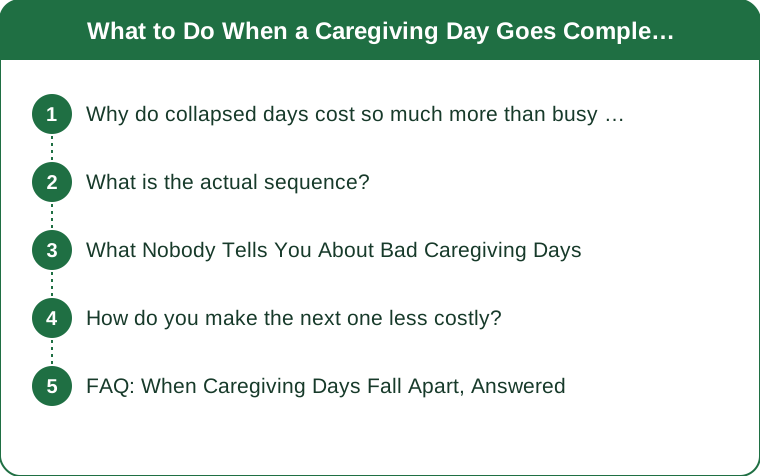
Why do collapsed days cost so much more than busy days?
Decision fatigue is the hidden cost. A day that goes to plan involves executing decisions you already made. A day that collapses requires making dozens of new ones under pressure, and the quality of every decision degrades as the day goes on.
The lost plan gets grieved as well as replaced. There’s a real emotional cost to losing the thing you were looking forward to - the appointment you’d arranged cover for, the hour to yourself - and it usually goes unacknowledged, which makes it heavier.
Everything postponed reappears tomorrow. A collapsed Tuesday makes Wednesday harder, and the compounding is what turns a bad day into a bad fortnight.
Your own basics are the first thing dropped. Meals, water, sitting down, medication. They’re the easiest things to defer and the ones that most directly determine how the rest of the day goes.
And guilt attaches to the wrong things. People finish a collapsed day feeling they handled it badly, when they in fact absorbed an unplanned crisis with no notice and no cover. The standard being applied isn’t reasonable.
The transition weeks make collapses more likely. Schedules restarting, appointment backlogs, and staff changes all cluster around now, so the coming weeks are statistically a higher-risk period than midsummer was.
What is the actual sequence?
Step one: stabilise, don’t solve. Deal with the immediate safety and comfort issue and nothing else. Not the knock-on consequences, not the phone calls - just the thing in front of you. Solving comes after stabilising.
Step two: name the two must-happens. Out loud or written down. Medication and a meal. A specific appointment and getting to bed. Two, not five. Everything else on today’s list is now optional, and naming them makes that concrete.
Step three: drop the rest properly. Not deferred to this evening, not squeezed in later - dropped. Half-dropping is what turns one collapsed day into a fortnight of catch-up. Write down the two or three genuinely time-sensitive things for tomorrow and let the rest go entirely.
Step four: two minutes of physical reset. Stand up, roll your shoulders back, extend your exhale, drink a glass of water. It sounds trivial and it changes the next hour, because the physical stress response has been running unaddressed since the moment things went wrong.
Step five: protect one thing of your own. One meal sitting down, fifteen minutes with a door closed, or a shower. Something with a start and an end. This is the step people skip and it’s the one that determines whether tomorrow is also a collapsed day.
And make the calls in one block. If the collapse generated phone calls, do them together with a written list rather than scattered through the day. Batching them halves the mental cost.

What Nobody Tells You About Bad Caregiving Days
The adrenaline crash comes later, and it’s often the worst part. You handle the crisis competently and then feel shaky, tearful, or blank two hours after it’s resolved. That’s a normal physiological descent, not a delayed failure to cope.
Competence gets punished. Handling collapsed days well means people around you assume you’re fine and stop offering. Saying explicitly that a day was hard, even when you managed it, is what keeps support available.
The plan wasn’t wasted. People feel foolish for having planned at all. But having a plan is what let you identify the two must-happens in thirty seconds instead of an hour.
Most collapses have a small number of repeat causes. Cancelled cover, a specific recurring medical issue, transport. Writing down what caused the last five bad days usually reveals two causes, and two causes can sometimes be planned for.
Nobody sees it. The invisibility of caregiving work is at its most acute on days like this, where enormous effort produces no visible outcome. That’s a real thing to feel, not a sign of self-pity.
And a bad day isn’t diagnostic. One collapsed day says nothing about whether you’re coping. A pattern of them, or a day where you frightened yourself, is different information - and that one is worth acting on.
How do you make the next one less costly?
Write the sequence down and put it somewhere physical. On the fridge, in the front of a notebook. The whole value is not having to generate it under pressure, and a sequence in your head isn’t accessible on a bad morning.
Keep an emergency version of the basics ready. Meals in the freezer, a snack in the bag, a phone charger in the room you end up in. Removing three small logistics problems from a collapsed day is disproportionately effective.
Have one person you message rather than think about messaging. Not for them to fix anything - just so the day is witnessed by someone. Deciding who in advance removes the barrier.
Build a five-minute reset you can do anywhere. Standing, in a corridor, in the car. Shoulders back, slow breathing with a long exhale, feet on the floor. It works in hospital corridors, which is where a lot of collapsed days end up.
Track collapsed days for a month. Date and cause, one line each. It converts an overwhelming feeling into a small dataset, and datasets sometimes have fixable patterns.
And take the accumulation seriously. This is general information, not medical advice. Persistent exhaustion, low mood, sleep that doesn’t restore, or feeling you can’t continue are worth raising with your GP or a carers’ support service - and in most areas a carer’s assessment is something you can request, which can open up practical support.
FAQ: When Caregiving Days Fall Apart, Answered
How do I cope when a caregiving day goes completely wrong?
Stabilise the immediate issue, name the two things that must happen today, drop everything else properly rather than deferring it, take a two-minute physical reset, and protect one thing of your own. Decide the sequence on a calm day so you’re not designing it under pressure.
Why do I feel worse after the crisis is over?
Coming down off a sustained stress response isn’t instant, and feeling shaky, tearful, or blank a couple of hours later is a normal physiological descent rather than a sign that you handled it badly.
Should I try to catch up on what I missed?
Not the same day. Write down anything genuinely time-sensitive for tomorrow and let the rest go entirely. Half-dropping tasks is what turns one difficult day into a difficult fortnight.
When should I ask for outside help?
When collapsed days are becoming a pattern rather than an exception, when exhaustion isn’t lifting with rest, or when you frightened yourself. A GP, a carers’ support organisation, or a carer’s assessment are all reasonable places to start.
TL;DR:
- Work a fixed sequence rather than improvising: stabilise, name two must-happens, drop the rest, reset physically, protect one thing of your own.
- Drop tasks properly rather than deferring them - half-dropping is what turns one bad day into a bad fortnight.
- The shaky, blank feeling two hours after a crisis is a normal stress descent, not delayed failure.
- Write the sequence down somewhere physical, and keep emergency basics ready to remove logistics from a bad day.
- Track causes for a month; most people find two repeat causes that can partly be planned for.
Handling a collapsed day well makes it invisible to everyone else. Say it was hard anyway - that’s what keeps help available.
Keep Reading
This article is for general informational purposes only and is not medical advice. Always consult a qualified health professional for guidance specific to you.