The Five-Minute Reset That Fits Between Caregiving Tasks
Quick Answer: Caregivers rarely have the uninterrupted hour that most self-care advice assumes, but short recovery periods repeated through the day are genuinely effective - the evidence on micro-breaks supports frequency over duration. A five-minute reset with three components - physical release, an extended exhale, and one sentence naming your own state - fits into the gap between tasks and can be repeated three or four times a day.
The advice to take time for yourself is not wrong. It is just written for someone with a different calendar.

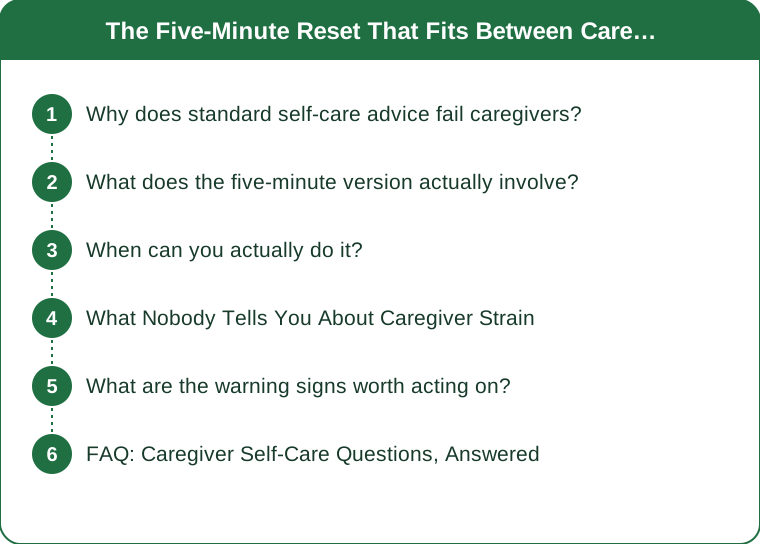
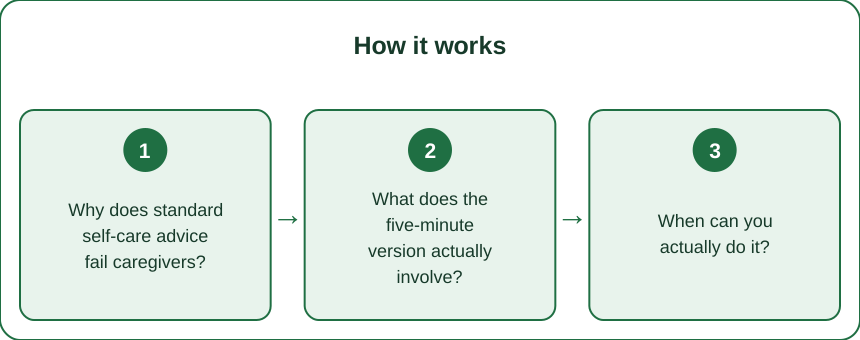
Why does standard self-care advice fail caregivers?
Because it assumes a resource you do not have, and then the failure to follow it becomes another thing to feel guilty about.
It assumes uninterrupted time. A bath, a class, an evening out - all require a block of time during which nobody needs you. For many caregivers that block does not exist on most days, and advice built on it is not merely unhelpful, it is actively demoralising.
It assumes the constraint is willingness. Most caregivers know perfectly well that they should rest. The barrier is availability, not motivation, and advice that addresses motivation misses the problem entirely.
It assumes recovery needs duration. This is the assumption most worth challenging, because the evidence on short recovery periods is reasonably encouraging - brief, frequent breaks during demanding work are associated with reduced fatigue and better sustained performance. Frequency does real work that duration was assumed to do.
And it ignores the specific shape of caregiver strain, which is not simply tiredness. It is sustained vigilance - being permanently available and permanently monitoring. Vigilance does not switch off just because you sat down, which is why passive rest often does not feel restorative and why an active reset works better.
What does the five-minute version actually involve?
Three components, roughly ninety seconds each, plus transitions. It can be done in a kitchen, a bathroom, or a parked car.
Component 1 - Physical release, about 90 seconds.
Caregiving loads specific places: shoulders, neck, lower back, jaw. Deliberately releasing them provides fast, noticeable feedback, which matters because it tells your system something has changed.
- Roll your shoulders back five times, slowly
- Drop your chin to your chest and let the weight of your head stretch your neck for 20 seconds
- Unclench your jaw and let your tongue drop from the roof of your mouth
- Open and close your hands ten times
Component 2 - Extended exhale, about 90 seconds.
In for a count of 4, out for a count of 8, for about eight cycles. A longer exhale than inhale shifts autonomic balance toward the parasympathetic side, and it is the fastest physiological lever available. Start with an exhale, not an inhale.
Component 3 - Name your own state, about 30 seconds.
One sentence, silently or aloud: I am exhausted and I am also worried about Thursday. Putting feelings into words is associated with reduced emotional intensity, and caregivers characteristically monitor someone else’s state continuously while never checking their own.
Then the transition back, deliberately. Do not rush the last thirty seconds - a reset that ends in a scramble undoes some of what it did.
When can you actually do it?
The technique is easy; finding the gap is the real problem, so it is worth being specific about where the gaps are.
The natural slots most caregiving days contain:
- After a transfer, a medication round, or a personal care task - there is almost always a moment before the next thing
- While the kettle boils, which is a genuine two to three minutes
- In the car, before going in or after arriving - the most protected private time many caregivers have
- In the bathroom. Unglamorous and frequently the only door that locks.
- During a nap, a TV programme, or any period of settled quiet
- In the gap between the person you care for going to bed and you going to bed - and it is worth protecting five minutes of it rather than immediately starting the household tasks
The instruction that matters most: do it before you are desperate. A reset at moderate strain is far more effective than one attempted at breaking point, and most caregivers only reach for anything at the peak.
Target three to four short resets a day rather than one longer one. Twenty minutes distributed across a day does more for sustained strain than twenty minutes in a single block, and it is available on days when a block is not.

What Nobody Tells You About Caregiver Strain
The vigilance is more depleting than the tasks. Physical caregiving work is tiring in an ordinary way. Being continuously alert for a call, a fall, a change - that is a different and more corrosive load, and it continues during rest, during sleep, and during time away. It is the main reason caregivers describe being tired in a way that sleep does not fix.
Guilt is nearly universal and it functions as an additional load. Guilt for resting, for feeling resentment, for not doing more, for wanting time away. Naming it as a normal feature of caregiving rather than a personal failing reduces its weight measurably, and most caregivers have never been told it is normal.
Caregiver health outcomes are a documented concern. Sustained caregiving is associated with higher rates of sleep problems, depression, and neglected personal healthcare. The advice to look after yourself is not sentimental - it reflects a real and measured risk, and skipping your own appointments is one of the most common and most consequential patterns.
Asking for help does not usually work as a general request. People say let me know if you need anything and nothing follows. Specific requests do work: could you sit with Mum on Tuesday from 2 to 4. Converting vague offers into specific slots is one of the highest-return things a caregiver can do.
Respite is not a luxury and it is not an admission of failure. In many places there are formal respite services, carer assessments, and financial support that go unclaimed simply because nobody mentioned them. A carer assessment is worth asking your local services about even if you assume you would not qualify.
And the hardest one: the resentment is not a character flaw. It is close to universal in sustained caregiving and it coexists perfectly well with love. It is information about your load, not about your feelings toward the person.
What are the warning signs worth acting on?
Some strain is expected. Some patterns warrant getting support rather than continuing.
Common, and worth monitoring:
- Tiredness that rest does not fully resolve
- Irritability that surprises you
- Reduced interest in things you used to enjoy
- Postponing your own appointments
Worth actively arranging support for:
- Sleep problems that persist for weeks
- Feeling numb or detached most of the time
- Withdrawing from friends and family beyond what time constraints explain
- Increasing reliance on alcohol to wind down
- Frequent crying, or feeling on the edge of it much of the time
- Physical symptoms - persistent headaches, stomach problems, frequent illness
Seek help promptly:
- Persistent hopelessness or feeling that things will not improve
- Any thoughts of harming yourself
- Fear that you might lose control with the person you care for, or having done so
- Being unable to function in daily tasks
That last group is not a reason for shame - it is a well-documented consequence of sustained unsupported caregiving, and it is precisely what respite services, carer support organisations and GPs exist for. Contact your doctor or a carers organisation. This is general information, not medical advice.
FAQ: Caregiver Self-Care Questions, Answered
Does five minutes really make a difference?
Short, frequent recovery breaks are supported as a fatigue management approach, particularly when repeated through a day. It will not resolve sustained strain on its own - it maintains capacity in the meantime, which is a real and worthwhile outcome.
How do I stop feeling guilty about taking any time?
Mostly by reframing it as maintenance of the thing the person depends on, and by knowing that the guilt is close to universal among caregivers. It tends to reduce with practice rather than disappearing on command.
What if I genuinely cannot leave them alone even for five minutes?
Do it in the room. The breathing and the physical release are invisible and work perfectly well while you are present and available.
How do I ask for help without it becoming another job?
Ask for one specific thing at a specific time, from one specific person. General requests generate general offers and no actual relief.
Where do I find respite or formal support?
Start with your local authority or health service carer assessment, and with national carers organisations - many offer advice lines, peer support, and information about services and financial support you may not know exist.
TL;DR:
- Standard self-care assumes an uninterrupted hour that most caregivers do not have
- Frequency beats duration - three or four five-minute resets a day outperform one long block
- Three components: physical release, extended exhale, and one sentence naming your own state
- Do it before you are desperate; the kettle, the car, and the bathroom are the reliable slots
- Persistent hopelessness, numbness, or fear of losing control need support now, not later
The vigilance is the load. Five minutes of putting it down is not nothing.
Keep Reading
This article is for general informational purposes only and is not medical advice. Always consult a qualified health professional for guidance specific to you.