The Ten Minutes Alone Problem: Why Caregivers Cannot Use the Break They Get
Quick Answer: Short caregiver breaks fail because you stay in monitoring mode the whole time — listening for the call, mentally rehearsing the next task. The fix is not more time; it is a defined transition. Two minutes of a physical exit ritual converts a 10-minute gap from anxious waiting into actual rest.
The help arrives. The door closes. You have ten free minutes for the first time all day.
And you spend all ten of them standing in the kitchen, unable to start anything, listening. Then the ten minutes are gone and you feel worse than before you had them.

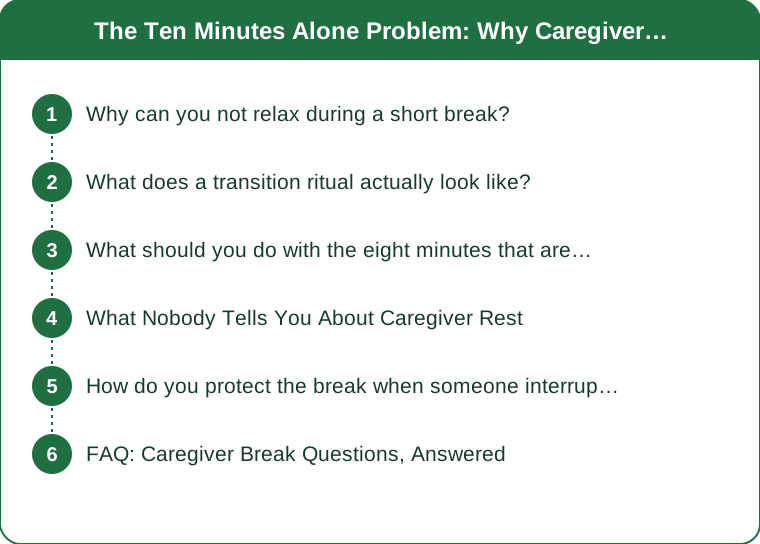
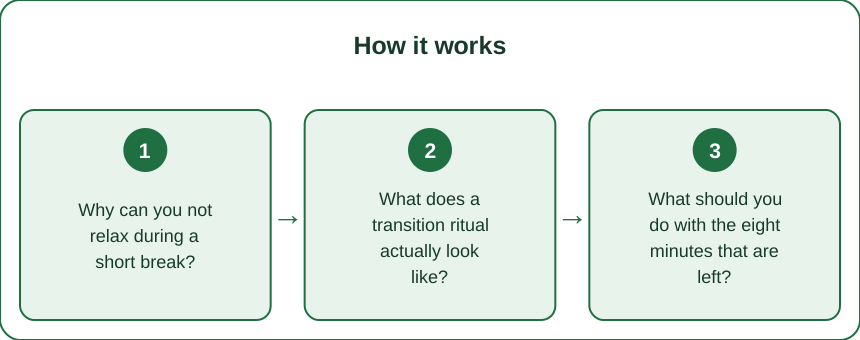
Why can you not relax during a short break?
Because the break ended your tasks but not your vigilance, and those are two separate systems.
Caregiving trains you into continuous low-level monitoring — one ear on the other room, one part of your attention perpetually tracking whether the person you care for is okay. That monitoring does not switch off when someone else takes over the physical work. It just loses its target and starts scanning.
So you get free time in the calendar and none in your nervous system. You cannot start a task, because starting means committing attention you might need to yank back. You cannot rest, because resting means lowering the guard.
This is why the standard advice — take time for yourself — lands so uselessly. The time was never the missing ingredient. The ability to transition out of monitoring is the missing ingredient, and nobody teaches it because most people have never had to build it deliberately.
What does a transition ritual actually look like?
It needs to be physical, short, and identical every time. The repetition is what does the work — you are building a signal your body learns to recognize.
A two-minute version that works for most people:
- Physically leave the room. Different room, porch, garden, car. Distance matters more than comfort here.
- Change one thing about your body. Wash your hands and face, take off an apron or a cardigan, put on different shoes. A small physical change marks the boundary.
- Six long exhales. In through the nose for 4, out through the mouth for 8. About 90 seconds.
- Say the handoff out loud. Literally: someone else has it for the next ten minutes. Out loud, not in your head — spoken words engage differently and interrupt the internal monitoring loop.
Then your remaining eight minutes are actually yours. It feels absurd the first few times. By the second week your body starts dropping the vigilance at step 2, before you have finished the sequence.
What should you do with the eight minutes that are left?
Choose deliberately, because the default — phone, scrolling — is the one option that reliably does not restore anything. It occupies attention without lowering activation, and you come back as depleted as you left.
What works in eight minutes:
- Going outside. Daylight and a short walk outperform almost everything else in this time window, and late-summer evenings are the easiest time of year to do it.
- Anything with your hands and no screen. Watering plants, sketching, stretching, playing an instrument badly.
- Lying flat on the floor with your legs up a wall. Five minutes. Unreasonably effective for anyone on their feet all day.
- One phone call to a person who is not about caregiving. Not a text — voice.
What does not work: starting a chore. It feels productive and it is the most common way a break gets eaten. The break is not a container for the tasks that piled up — those tasks will still exist, and the break will not come again today.

What Nobody Tells You About Caregiver Rest
Rest often feels worse before it feels better. The first few genuine breaks frequently bring a wave of exhaustion, tearfulness, or irritability. That is not the rest failing — that is what was underneath the vigilance becoming visible once the vigilance drops. It settles with repetition.
Short and frequent beats long and rare. Three 10-minute breaks distributed through a day restore more than a single 30-minute block, because each one interrupts the accumulation. If you are waiting for a respite weekend to recover, you will be waiting a long time and running on empty in the meantime.
Guilt spikes hardest at the start of a break, not during it. Knowing this helps enormously. The worst 60 seconds are the first 60, which is precisely when people abandon the break and go back. Ride out the first minute and the rest is much easier.
The person you care for often benefits from your break more than from the extra ten minutes of your presence. Depleted caregiving is more irritable, less patient, and more error-prone. This is not selfishness reframed — it is the actual mechanism.
How do you protect the break when someone interrupts it?
They will. The phone rings, someone needs a question answered, a family member calls to check in during the exact ten minutes.
Set the terms out loud before you leave the room. Specific and brief: I am taking ten minutes. Unless something is urgent, it can wait until 4:15. Most interruptions are not urgent — they are habitual, and they stop when the boundary is stated once clearly.
Put the phone somewhere else. Not on silent in your pocket, physically in another room. A phone in your pocket keeps the monitoring circuit running whether it rings or not.
Decide the one exception in advance. Usually one specific person or one specific circumstance. Naming the exception is what lets you ignore everything else without anxiety, because you know what the real alarm looks like.
And if the breaks keep getting eaten no matter what you do, that is worth naming to whoever shares the care with you — not as a complaint, but as a scheduling fact. Ten protected minutes is a small ask, and most people say yes when it is asked plainly.
If exhaustion has tipped into persistent hopelessness, sleep you cannot recover from, or feeling unable to continue, that is beyond what a break can address — talk to your doctor or contact a caregiver support line. This is general information, not medical advice.
FAQ: Caregiver Break Questions, Answered
How often should I be taking breaks?
More often and shorter than most caregivers assume. Aim for a 10-minute break every three to four waking hours rather than one long stretch. Frequency is what keeps depletion from compounding.
I only get five minutes. Is that even worth it?
Yes, and the transition ritual matters more, not less, at that length. Compress it: leave the room, six long exhales, say the handoff out loud. That is 90 seconds, leaving three and a half minutes of real rest — which is meaningfully different from five minutes of standing in the kitchen listening.
Why do I feel guilty even when someone else is covering?
Because the vigilance has not stopped, and unspent vigilance tends to present as guilt. It is usually a nervous system signal rather than a moral one. It fades as the transition ritual gets established, though it rarely disappears completely — the goal is for it to stop deciding what you do.
TL;DR: The problem was never the length of the break — it is that you never left monitoring mode.
- Build a two-minute transition ritual: leave the room, change one physical thing, six long exhales, say the handoff out loud.
- Do it identically every time. The repetition is what teaches your body to drop the vigilance.
- Spend the remaining minutes on daylight, hands, or lying flat — not on your phone and not on a chore.
- Expect the first 60 seconds to be the hardest, and expect early breaks to surface tiredness rather than relief.
- State the boundary out loud before you leave, and put the phone in another room.
- Short and frequent beats long and rare — every three to four hours, not once a week.
Ten minutes is enough. It just has to be ten minutes you are actually inside of.
Keep Reading
This article is for general informational purposes only and is not medical advice. Always consult a qualified health professional for guidance specific to you.