Lifting, Transferring, Supporting: Strength Skills for Caregivers
Quick Answer: Safe caregiver lifting comes down to hinging at the hips instead of bending your spine, keeping the load close to your body, counting down together before any lift, and building a short strength routine (squats, hinges, carries, planks) so your body can handle the job.
You didn’t apply for a physically demanding job. It just showed up, wrapped in love and a to-do list, and now your back is doing shift work it never signed up for.
Hospitals train staff for months on safe patient handling. Family caregivers usually get a pamphlet, if that — and the physics doesn’t care which one you are.

What’s the single most important rule for lifting safely?
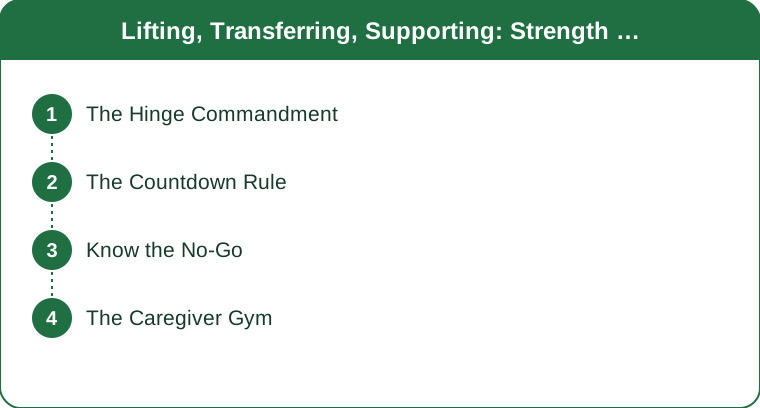
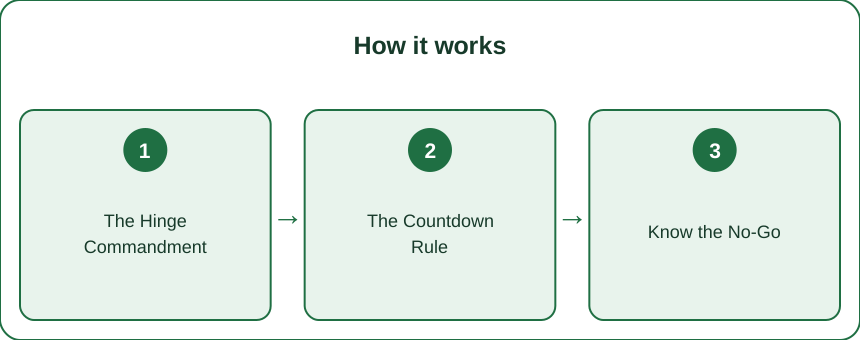
Bend at the hips, not the spine — this is the one rule that matters more than any other in caregiving. Think of it as a hinge, like a drawbridge, with your chest staying proud and your back staying long instead of rounding forward.
This applies to everything, not just lifting a person: laundry baskets, grocery bags, a dropped TV remote you’ve bent over for a hundred times without thinking. Keep the load as close to your body as possible while you do it — the farther an object sits from your torso, the more leverage it has against your lower back.
A few quick form checks to run through:
- Feet shoulder-width apart, one slightly staggered for balance.
- Chest up, shoulders back, core gently braced.
- Load held close, not out at arm’s length.
- Power coming from your legs and hips, not your lower back.
Get this hinge pattern automatic and you’ve solved most of the risk before you even touch anyone.
How do you lift or transfer a person without hurting either of you?
Never lift someone by surprise — it’s the fastest way to get an unpredictable, uncoordinated load. Count down together out loud (“on three”) so you move at the same moment, and let them contribute whatever strength or movement they still have.
Cooperation does something lifting alone can’t: it roughly halves the effective load, because you’re no longer moving dead weight by yourself. Choreography — agreeing on the count, the direction, and who’s doing what — prevents the sudden lurch that throws out backs.

Stagger your feet like a mini lunge stance before you begin, so you have a stable base in the direction you’re about to move. This single adjustment does a lot of the balance work for you before the lift even starts.
When should you not attempt a lift at all?
A person who is actively falling cannot be caught safely — trying to catch full body weight from an awkward position is how you both end up hurt. Guide them down slowly instead of catching them, protecting the head as the priority, and let the rest of the fall happen in a controlled way.
It feels instinctively wrong to “let” someone go down. But controlled lowering protects both of you far better than a catch that throws your spine into a twisted, loaded position with no warning.
After any fall or near-fall, call for help before attempting a solo lift back up. Heroic one-person hoists are exactly the situation that injures caregivers most often — a fall risk for them can become a back injury for you within seconds.
What does a caregiver-specific strength routine actually look like?
You perform lifting, hinging, and carrying movements daily, often under load and often at awkward angles — so training those same patterns off-duty is occupational insurance, not vanity. Ten minutes, three times a week, is enough to notice a real difference.
A simple rotation to build from:
- Squats — the leg strength behind every stand-to-sit transfer.
- Hinges (a deadlift pattern, using any household weight) — reinforces the exact bend-at-hips pattern you need during lifts.
- Carries — walking with a weight in each hand builds the grip and core stability that laundry baskets and grocery bags demand daily.
- Planks — a stable core is what keeps your spine protected when a lift doesn’t go exactly as planned.
Start light. The goal isn’t to become a powerlifter — it’s to make sure your body can handle the job you’re already doing every single day.
What Nobody Tells You About Caregiver Injuries
Most caregiver back injuries don’t happen during one dramatic lift — they build up from dozens of small, slightly-off movements repeated over weeks and months. The bad habit that finally “does it” is usually the same hinge shortcut you’d been getting away with for a while.
Caregivers also tend to deprioritize their own strength training because it feels self-indulgent when someone else clearly needs more help. In reality, your strength is part of their care plan — if your back gives out, their care gets worse, not better.
And a caregiver’s job rarely comes with rest days built in the way a training program would recommend. That’s exactly why the short, off-duty strength routine matters: it’s recovery-adjacent maintenance for a body that doesn’t get to clock out.
If you notice ongoing pain, numbness, or a specific movement that consistently hurts, that’s a signal worth taking to a doctor or physical therapist rather than pushing through — a professional can catch a developing issue long before it becomes a disabling one.
FAQ: Safe Lifting for Caregivers
What’s the biggest mistake caregivers make when lifting?
Bending at the spine instead of the hips is the most common and most damaging mistake. It shifts load onto the lower back instead of the stronger leg and hip muscles, and repeated over time it’s a major driver of caregiver back injuries.
Should I try to catch someone who’s falling?
No — guiding a falling person down in a controlled way, while protecting their head, is safer than attempting a full catch. Catching full body weight from an unstable position risks serious injury to both of you.
How often should caregivers do strength training?
Roughly ten minutes, three times a week, focused on squats, hinges, carries, and planks is enough to build meaningful protection. Consistency matters more than intensity — these are maintenance sessions, not workouts to max out.
TL;DR:
- Hinge at the hips, not the spine, and keep loads close to your body for every lift, not just patient transfers.
- Count down together before lifting or transferring someone so you move in sync and share the effort.
- Never try to catch a falling person — guide them down and protect the head instead.
- Call for help rather than attempting a solo hoist after a fall.
- Ten minutes, three times a week of squats, hinges, carries, and planks keeps your body ready for the job.
Keep Reading
This article is for general informational purposes only and is not medical advice. Always consult a qualified health professional for guidance specific to you.