Sleep When You're the One on Call: Rest Strategies for Caregivers
Quick Answer: You can’t control the interruptions, so protect the sleep around them. Anchor one non-negotiable block (say 11pm–4am) with whatever backup coverage you can arrange, train rapid re-entry after wakings (minimal light, phone untouched, slow exhales), take a 20-minute nap when they nap, and staff one fully protected night per week. Five anchored hours beat eight theoretical ones.
Caregiver sleep is its own genre. One ear permanently open. A monitor glowing on the nightstand like a small anxious moon. Rest that ends mid-dream, three times, and starts over each time from scratch.
And then the advice you find is about blue light and lavender, written for people whose main sleep problem is scrolling.
You can’t always control the interruptions. But the sleep around them can be defended, and defending it is the difference between running on fumes and running on empty.

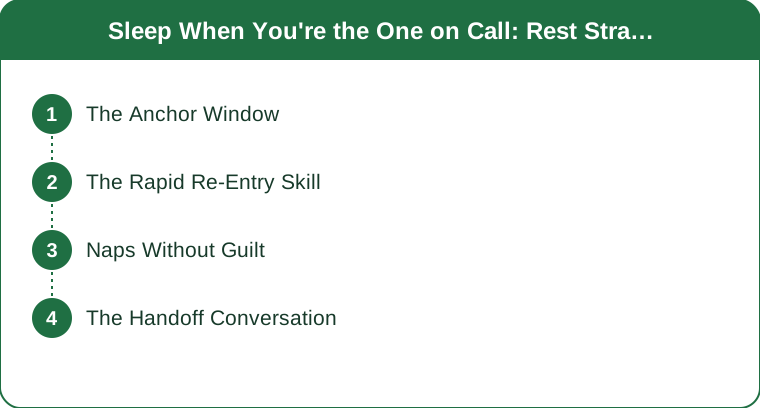
How Do You Protect Sleep When You’re On Call All Night?
Stop chasing eight hours. Anchor five.
Pick one block — 11pm to 4am, or 10 to 3, whatever fits the pattern of the person you’re caring for — and defend it with any backup coverage you can arrange, negotiate, or trade for. Five hours of protected, anchored sleep beats eight hours of theoretical sleep that gets shredded into six fragments.
The reason is architecture. Deep slow-wave sleep is front-loaded into the first few hours of a sleep period, and REM is concentrated later. Fragmented sleep interrupts both cycles repeatedly and never lets either complete properly. A shorter unbroken block gives you more usable sleep than a longer broken one, which is counterintuitive enough that most people never try it.
Guard the window like it’s an appointment, because functionally it is. Tell whoever else is in the house. Put it on the shared calendar if there is one. The block only works if it’s visible to other people.
How Do You Fall Back Asleep After Being Woken Up?
Re-entry is a skill, and it’s trainable. Most caregivers lose more sleep to the twenty minutes after a waking than to the waking itself.
Four rules, in order of how much they cost you when broken:
- Don’t touch the phone. One glance at a screen at 3am is worth roughly forty minutes of accidental news, email, or something upsetting you can’t act on until morning. This is the single biggest leak.
- Keep the light minimal. A dim red or amber nightlight rather than an overhead. Bright light at 3am tells your circadian system the day has started.
- Go back to bed even if you don’t feel sleepy. Lying down in the dark is restorative even before sleep arrives, and staying up “until I feel tired” usually means staying up.
- Slow exhales. Breathe in for four, out for six or eight. Extending the exhale nudges the parasympathetic system, and it’s the one technique here that works within about ninety seconds.
None of this is dramatic. It compounds nightly, which is the point — a caregiver who re-enters in eight minutes instead of thirty gains something like two hours of sleep a week.

Are Naps Actually Worth It for Caregivers?
Yes, and the guilt around them is the real problem.
A 20-minute nap while they nap is not laziness — it’s shift work recovery, and every industry that runs people through interrupted nights builds naps into the protocol deliberately. Air traffic control does it. Hospital residency programs do it. You’re doing shift work with worse hours and no HR department.
The specifics matter:
- Set an alarm for 20–25 minutes. Past about thirty you start entering deep sleep, and waking out of that produces the groggy, worse-than-before feeling that makes people swear off napping.
- Earlier is better. Before 3pm, ideally, so it doesn’t eat into the night block.
- Dark and flat if possible. A twenty-minute nap lying down is worth considerably more than forty minutes upright in a chair.
You’ll wake up meaningfully more functional. The laundry has no feelings about waiting twenty minutes.
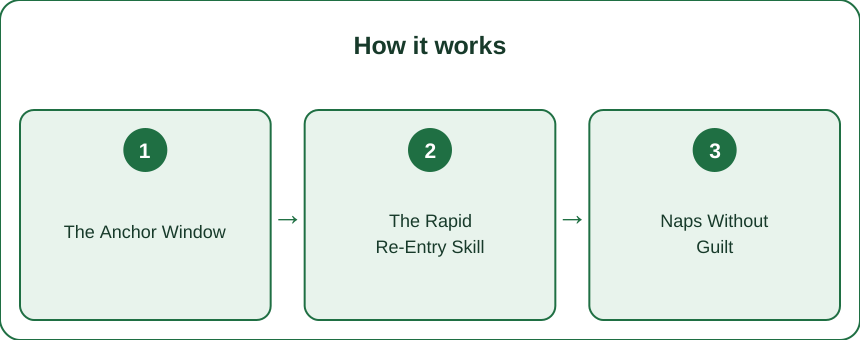
What Nobody Tells You About Caregiver Sleep Debt
Monitor anxiety is real and it’s not the same as being woken. Plenty of caregivers report lying awake listening to a monitor that hasn’t made a sound. If that’s the pattern, moving the monitor slightly further away, lowering the volume to the minimum that still works, or alternating nights with someone else is worth trying — the hypervigilance itself is costing you sleep independent of any actual interruption.
Chronic sleep debt degrades exactly the faculties caregiving runs on. Patience, emotional regulation, working memory, and judgment are among the first things to go, and they degrade before you notice them degrading. The irritation you feel guilty about at 4pm is frequently a sleep symptom wearing a moral costume.
One protected full night per week is not a luxury. A relative, a respite service, a paid overnight, a trade with another caregiver. Staffing the night is a form of care, not an abdication of it — the person you’re caring for gets a better version of you for the other six.
Respite services exist and are chronically underused. Many regions have subsidized or free respite programs that caregivers never find out about. It’s worth an hour of searching or one call to a local aging or disability services office.
Know when this stops being a sleep problem. If you’re sleeping when you get the chance and still exhausted, if you’re waking with a racing heart, if the low mood has been there for weeks, or if you’ve stopped being able to sleep even when covered — talk to a doctor. Caregiver burnout, depression, and sleep disorders overlap heavily, and untangling them is not something to do alone at 4am.
Mini FAQ
How much sleep do caregivers actually need?
The same 7–9 hours everyone needs, which is exactly the problem — the gap between need and reality is the thing you’re managing. In practice, aim for one protected block of at least five hours plus a daytime nap, and treat that as the floor rather than the goal.
Is fragmented sleep as bad as short sleep?
Research suggests fragmented sleep is often worse than a shorter unbroken night at the same total duration, because repeated waking prevents completion of deep and REM cycles. That’s the entire case for anchoring a block instead of chasing total hours.
How do you ask for help with overnight care?
Ask for something specific and bounded rather than open-ended. “Could you take Tuesday night once a month?” gets a yes far more often than “I could use some help.” People generally want to help and don’t know what to offer — naming the exact night and the exact task removes the obstacle.
TL;DR:
- Anchor one protected five-hour block rather than chasing eight fragmented hours.
- Re-entry is trainable: no phone, minimal light, back to bed regardless, long slow exhales.
- The 20-minute nap is shift-work recovery, not laziness. Set an alarm, keep it before 3pm.
- Staff one fully protected night a week — sleep debt degrades exactly the patience caregiving requires.
- Persistent exhaustion despite sleep, or low mood lasting weeks, is a doctor conversation, not a scheduling one.
Anchor the window, master re-entry, nap on purpose, staff one full night. You can’t pour from an empty cup — and you certainly can’t pour from one that hasn’t slept since Tuesday.
Keep Reading
This article is for general informational purposes only and is not medical advice. Always consult a qualified health professional for guidance specific to you.