Why Caregiver Shoulder Pain Is Almost Always on One Side - and What Fixes It
Quick Answer: Caregiving involves a large number of repeated asymmetric tasks - the same bag on the same shoulder, reaching across a bed from the same side, supporting someone with the same arm. Load that repeats on one side without recovery produces one-sided shoulder pain. The fix is to alternate sides deliberately, reduce the reach distance, and add two minutes a day of upper back and rotator cuff work rather than stretching the sore spot.
The sore shoulder is usually the one doing the work. The interesting question is which side is not doing any.

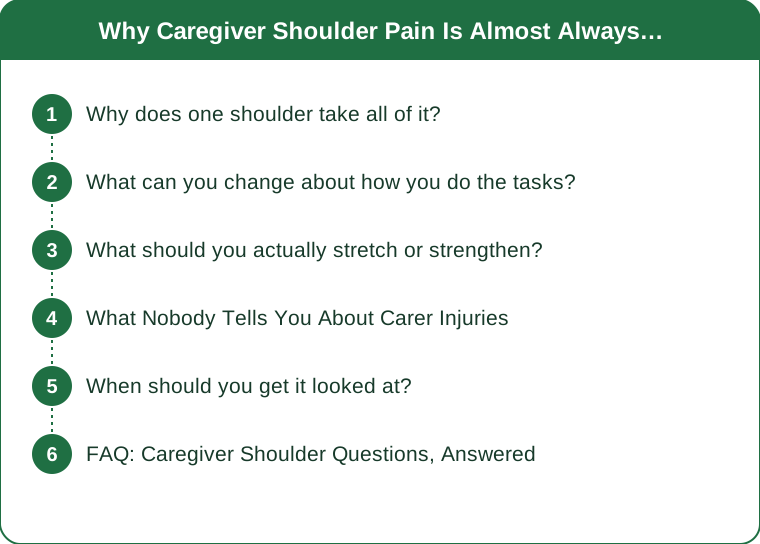
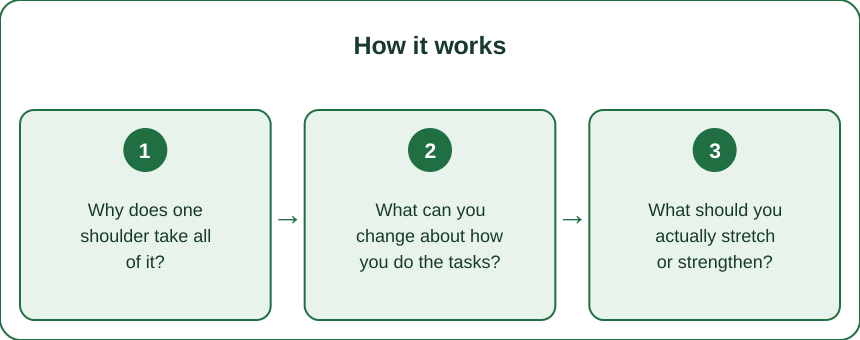
Why does one shoulder take all of it?
Because caregiving tasks have a fixed geometry, and once you find a way that works you repeat it hundreds of times.
The repeated tasks that produce it:
- Reaching across a bed to adjust pillows, help someone sit, or change bedding. The bed is against a wall on one side, so you always approach from the same side
- Supporting someone’s weight with the same arm while they walk or stand
- Carrying the bag - medications, water, notes, spare clothes - on the shoulder that is not the supporting one
- Opening the same doors, pushing the same wheelchair, adjusting the same chair
- Bracing while lifting, where one arm takes the load and the other stabilises
The common factor is reach with load at a distance from your body. The further the weight is from your trunk, the more torque the shoulder has to control. Reaching across a bed to lift is one of the highest-load positions the shoulder encounters in ordinary life, and it is also one of the most repeated in caregiving.
What actually gets irritated: typically the rotator cuff tendons and the surrounding structures, which get compressed when the arm works overhead or across the body repeatedly without the upper back muscles supporting the position. The upper trapezius takes over, gets tight and painful, and gets blamed for the problem it is compensating for.
Why it becomes chronic in caregivers specifically. Recovery requires reduced load, and the load is a person who needs help tomorrow. That is a genuine constraint, not an excuse, and it means the approach has to be about redistributing the load rather than removing it.
What can you change about how you do the tasks?
Four changes, none of which require anyone else’s cooperation.
1. Get closer before you lift. Reaching across creates the torque. Moving the bed away from the wall by even 30cm, or walking around to the other side, or asking the person to shift toward you first, cuts the lever arm substantially. The distance between the load and your body is the single biggest factor in shoulder strain and it is almost always adjustable.
2. Alternate deliberately. This is the change with the highest return and the lowest cost. The bag goes on the other shoulder. You approach the bed from the other side once a day. You open the door with the other hand. Alternating does not double the strain on the good side - it halves the strain on both, because neither reaches the threshold where irritation begins.
3. Use two hands and your legs. Anything that can be a two-handed task in front of your body rather than a one-handed task to the side should be. Lifting with a bent knee and a neutral spine, close in, uses the strongest structures rather than the most vulnerable ones.
4. Set the bag down. Carrying is cumulative, and a bag carried for ninety minutes of appointments is a ninety-minute isometric hold on one shoulder. A backpack distributes it across both sides and is the single easiest equipment change available.
On equipment more generally: a transfer belt, a slide sheet, a bed rail, or a raised bed height all reduce shoulder load substantially, and many are inexpensive or available through local services. Occupational therapy assessments exist specifically for this and are chronically underused by family carers, who often do not know they can ask.
What should you actually stretch or strengthen?
Mostly strengthen, and mostly the back rather than the sore spot.
Why stretching the sore shoulder often fails. The tight upper trapezius is usually compensating for weak or inactive muscles between the shoulder blades. Stretching it gives 20 minutes of relief and no change, because the compensation restarts as soon as you pick anything up.
Four movements, two minutes total, most days:
Scapular retraction. Stand or sit, arms at your sides, and draw your shoulder blades down and back - as if putting them in your back pockets. Hold 5 seconds, release. Ten times. This is the foundational one and it is nearly invisible, so it can be done anywhere.
Wall slides. Stand with your back and arms against a wall, elbows bent at 90 degrees. Slide your arms up the wall as far as you can while keeping contact, then back down. Ten slow repetitions. Excellent for the reaching-overhead pattern.
External rotation with a band. Elbow tucked at your side, bent at 90 degrees, rotate your forearm outward against a light resistance band. Fifteen each side. This directly targets the rotator cuff muscles that get overwhelmed by repeated reaching.
Doorway pec stretch. Forearm on the door frame, elbow at shoulder height, step through gently. Thirty seconds each side. The one genuine stretch worth doing, because rounded shoulders from carrying tighten the chest and pull the shoulder forward into the position that irritates it.
Frequency beats duration. Two minutes most days does more than twenty minutes on Sunday. Attach it to something that already happens - waiting for the kettle, after the morning medication round, during a television advert.
On heat and cold: heat before activity helps a stiff shoulder move. Cold after a heavy day helps an irritated one settle. Neither treats the cause and both are legitimate for managing a day.

What Nobody Tells You About Carer Injuries
Four things that carers consistently discover late.
The injury usually arrives after the crisis, not during it. During an acute period, adrenaline and necessity carry you. The shoulder tends to become genuinely painful two or three weeks later, when things have settled - which makes the cause hard to identify and easy to dismiss as unrelated.
The pain often shows up somewhere else first. Neck stiffness, headaches at the base of the skull, and a burning between the shoulder blades commonly precede shoulder pain by weeks. Those are early signals from the same pattern, and they are the point at which two minutes a day would have been enough.
Carers systematically underreport. In a medical appointment about the person you care for, your own shoulder does not come up. It is worth booking a separate appointment for yourself rather than trying to raise it in theirs - the ten minutes are not yours in that room, and everyone involved knows it.
Sleep position matters more than expected. Lying on the painful shoulder all night compresses the exact structures that were irritated all day, which is why the pain is often worst first thing in the morning. A pillow hugged to the chest while lying on the other side keeps the top arm supported and takes pressure off both shoulders - a small change with a disproportionate effect.
And the one that surprises people most: carers often have significant strength in the working side and noticeable weakness on the other, to the point where the imbalance is visible. Training the weaker side is not vanity, it is what allows you to alternate - and alternating is the actual fix.
When should you get it looked at?
Sooner than most carers do, and there are specific signals worth acting on.
Get it assessed if:
- Pain wakes you at night or you cannot lie on that side at all
- You cannot lift your arm above shoulder height, or lifting it produces a sharp catch
- There is numbness, tingling, or weakness in the arm or hand, which can indicate nerve involvement rather than a local shoulder problem
- The pain has lasted more than a few weeks without improving
- You dropped something or felt a sudden tear during a lift
- The shoulder is losing range - noticeably stiffer than it was a month ago, which can be the start of a frozen shoulder and is much easier to treat early
What to ask for: a physiotherapy referral is the usual starting point and is genuinely effective for most repetitive-strain shoulder problems. Ask specifically about your caregiving tasks - a physiotherapist who knows you reach across a bed forty times a day will give you different advice from one who does not.
What else is worth asking about: whether an occupational therapy assessment of the home setup is available, whether equipment can be provided, and whether any respite or care support exists locally. The equipment route often removes more strain than any exercise programme, and it is the one carers least often pursue.
On the wider point. A shoulder injury that stops you lifting is a threat to the whole care arrangement, not a personal inconvenience. Framing it that way is not selfish and it is often what makes both you and the professionals treat it with appropriate urgency. Carers who stay well provide care for longer, and that is the honest argument for booking the appointment.
This is general information rather than medical advice. Persistent shoulder pain, night pain, weakness, or numbness should be assessed by a doctor or physiotherapist rather than managed with exercises alone.
FAQ: Caregiver Shoulder Questions, Answered
Why is it always the same shoulder?
Because caregiving tasks have fixed geometry - the same side of the bed, the same carrying arm, the same doors. Repeated load on one side without recovery is what produces one-sided pain.
Should I stretch the sore shoulder?
A doorway chest stretch helps. Stretching the tight upper trapezius gives short-term relief without changing the cause - strengthening the upper back and rotator cuff is what actually shifts it.
Is a backpack really better than a shoulder bag?
Yes, substantially. It distributes the load across both shoulders and removes a long isometric hold on one side, which is a large part of the total daily strain.
How long should exercises take?
Two minutes, most days. Frequency matters far more than duration for this pattern, and short sessions attached to an existing routine are the ones that survive.
When should I see someone about it?
If it wakes you at night, if you cannot raise your arm to shoulder height, if there is numbness or weakness, or if it has not improved in a few weeks.
TL;DR:
- One-sided caregiver shoulder pain comes from repeated asymmetric tasks with the load held away from your body
- Reduce the reach distance first - moving the bed, moving closer, or approaching from the other side cuts the strain more than anything else
- Alternate deliberately: the bag, the door, the side of the bed. It halves the load on both sides
- Strengthen the upper back and rotator cuff for two minutes a day rather than stretching the sore spot
- Night pain, weakness, numbness, or losing range are reasons to be assessed rather than to carry on
A shoulder that gives out is a threat to the whole arrangement. Booking the appointment is part of the caregiving, not a break from it.
Keep Reading
This article is for general informational purposes only and is not medical advice. Always consult a qualified health professional for guidance specific to you.