What Self-Care Actually Looks Like When You Only Have 5 Minutes as a Caregiver
Quick Answer: Five-minute caregiver self-care that actually works includes box breathing, stepping outside for fresh air, a two-minute stretch, or drinking a full glass of water slowly and intentionally — the point is a genuine nervous-system reset, not a spa-length ritual.
Self-care advice usually assumes an hour of free time that caregiving doesn’t leave. Five real minutes, used well, changes more than most people expect.

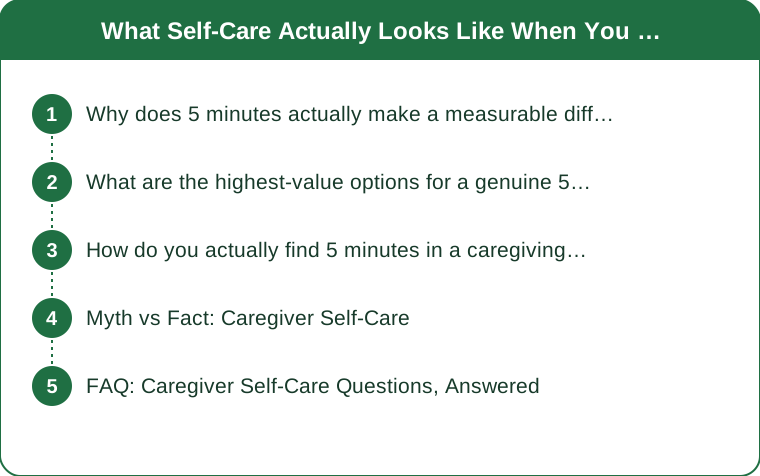
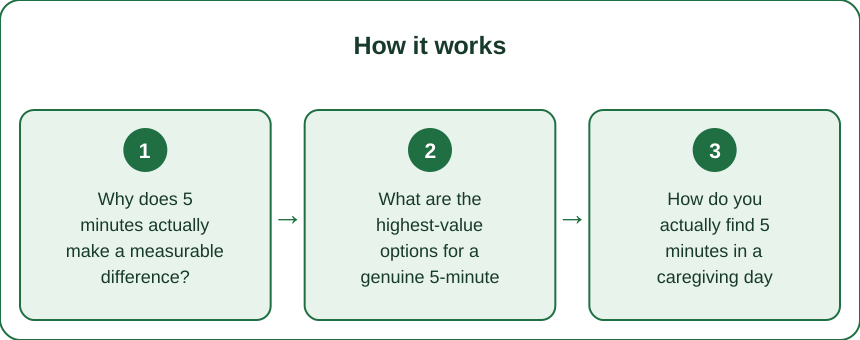
Why does 5 minutes actually make a measurable difference?
The nervous system’s stress response can shift meaningfully within just a few minutes of slower breathing or a brief change of environment — you don’t need a long session to trigger a real physiological reset, just a focused one. The barrier for caregivers usually isn’t the amount of benefit, it’s believing something this short counts at all.
What are the highest-value options for a genuine 5-minute reset?
Box breathing (4 counts in, 4 hold, 4 out, 4 hold, repeated for a few rounds) lowers physical stress markers quickly. Stepping outside, even onto a porch, changes light and air in a way that measurably shifts mood. A slow stretch of the neck and shoulders releases tension that builds up during long stretches of caregiving tasks.

How do you actually find 5 minutes in a caregiving day that has none?
Attach the reset to something already happening rather than trying to carve out new time — during a loved one’s nap, while something’s in the microwave, or right after a task transition. Treating it as attached to an existing pause, rather than a separate appointment, is what makes it realistically repeatable.
Myth vs Fact: Caregiver Self-Care
Myth: Self-care that’s too short ‘doesn’t really count.’ Fact: a focused 5-minute reset produces a measurable stress-response shift — length matters less than whether you’re actually present for it.
Myth: Self-care requires being away from the person you’re caring for. Fact: several effective resets (breathing, a stretch) can happen in the same room without leaving anyone unattended.
Myth: If you don’t feel dramatically better afterward, it didn’t work. Fact: the goal of a 5-minute reset is a small downshift, not full relief — expecting a bigger change than that sets you up to dismiss something that’s actually helping.
FAQ: Caregiver Self-Care Questions, Answered
Does this replace needing longer breaks eventually?
No — 5-minute resets are a bridge for the day-to-day, not a substitute for eventually arranging longer respite time, which most caregivers still need periodically.
What if even 5 minutes feels impossible to find some days?
On those days, even one minute of slow breathing while standing still counts — the goal is any genuine pause, not hitting a specific number.
Is it selfish to prioritize even 5 minutes for yourself?
No — caregiver burnout directly reduces the quality of care you’re able to provide, so brief, regular resets are part of sustaining the care, not competing with it.
TL;DR:
- A focused 5-minute reset produces a real, measurable stress-response shift
- Box breathing, stepping outside, and a shoulder stretch are the highest-value quick options
- Attach the reset to an existing pause in the day rather than trying to schedule new time
- Short resets support sustainable caregiving, they’re not a substitute for eventual longer breaks
Pick one option from this list and try it during your very next natural pause today — that’s the whole ask.
Keep Reading
This article is for general informational purposes only and is not medical advice. Always consult a qualified health professional for guidance specific to you.