When the Schedule Changes Again: Rebuilding a Caregiver Routine Without Starting Over
Quick Answer: When a caregiving schedule changes, the mistake is rebuilding the whole routine. Identify which specific anchors broke - usually two or three - and replace only those, keeping everything that still works. Protect your own non-negotiable first, before the rest of the week fills in, because it is the item that gets absorbed by default.
A schedule change in a caregiving household is rarely one change. It is a term start, a new appointment pattern, a shift in someone’s needs, and it all lands in the same fortnight.

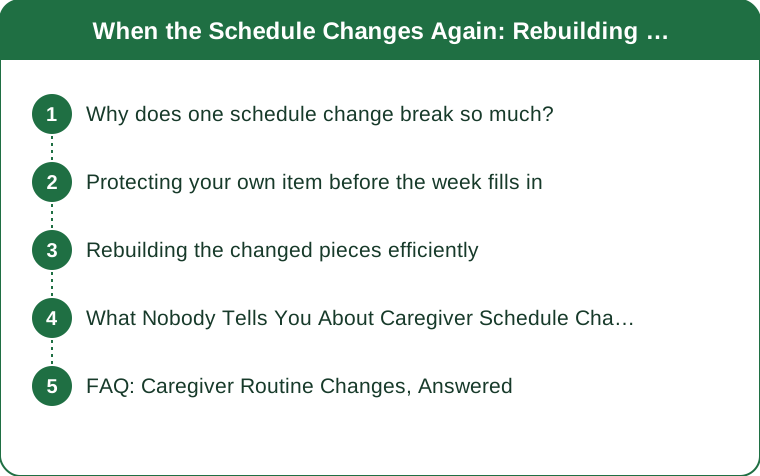
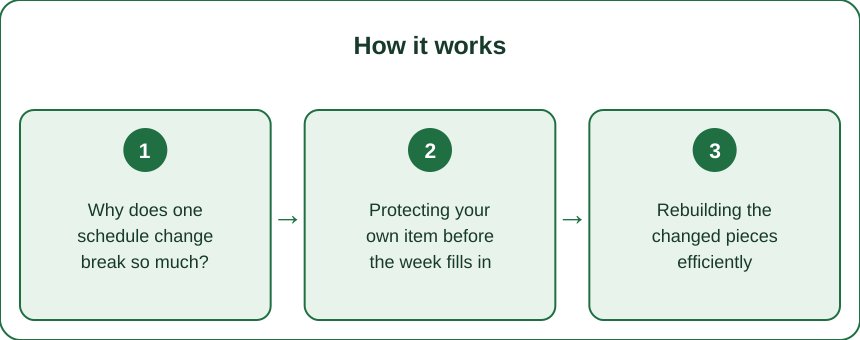
Why does one schedule change break so much?
Because caregiving routines are held together by a small number of load-bearing anchors, and everything else hangs off them.
A typical week has three or four genuine anchors - the morning handover, a regular appointment, a period when someone else is present, a reliable quiet hour. Everything else is arranged around those.
When one anchor moves:
- Everything downstream of it shifts, often by more than the original change
- The flexible items get squeezed first - and your own things are almost always the flexible items
- The routine feels entirely broken when in fact one piece moved
Why it feels worse than it is: the experience is of total collapse, so the instinct is a total rebuild. Rebuilding everything discards the parts that were working, and it is exhausting at exactly the moment you have least capacity.
The diagnostic that helps, and it takes fifteen minutes:
- Write the old week out - the actual one, not the intended one
- Mark what genuinely changed. Usually two or three items.
- Mark what is unaffected. Usually most of it.
- Rebuild only around the changed items
The finding is nearly always the same: the week is 80 percent intact and it did not feel that way at all.
Protecting your own item before the week fills in
The single most useful structural habit in caregiving, and the hardest to hold.
Why your own things disappear first. They are the only items in the week with no external accountability. A medical appointment has a time and a consequence; a walk does not. In a compressed week, items without external structure get absorbed by items with it - reliably, and without any decision being made.
The countermeasure: give your item external structure.
- Put it in the shared calendar with a name, not as free time
- Attach it to something fixed - during an appointment, immediately after a specific handover, while someone else is present
- Make it small enough to be undeniable. Twenty minutes is much harder to argue away than 90.
Choosing the right item: one thing, chosen for restoration rather than productivity.
- Movement, sleep, or genuine quiet tend to have the highest return
- Outdoors beats indoors where possible - light exposure supports both sleep and mood
- Not admin. Doing paperwork in your protected slot is the most common way people lose it without noticing.
On the guilt, which is nearly universal: caregiver burnout is a well-documented phenomenon with real consequences for both the carer and the person being cared for. Maintaining your own capacity is part of the caregiving, not separate from it. That framing does not remove the guilt, but it does make the slot easier to defend.
If you are experiencing persistent exhaustion, low mood, sleep problems, or a sense of not coping, speak to your GP or a caregiver support organisation. These are common and there is real support available - this is general information, not medical advice.

Rebuilding the changed pieces efficiently
Once you know which anchors moved, the rebuild is smaller than it feels.
Step 1: Re-anchor, do not re-plan. For each broken item, ask only one question: what fixed point in the new week can this attach to? Not when would it ideally happen - what actually recurs.
Step 2: Accept a worse version temporarily. A 20-minute walk instead of 45. A simpler meal pattern for a fortnight. The reduced version preserves the structure, and structure is what you rebuild from once things settle.
Step 3: Batch the newly variable things. When a previously fixed item becomes unpredictable, batching reduces the decision load:
- One shop rather than several
- One admin block rather than admin scattered through the week
- Meals prepared in batches, which is the highest-return batching in most caregiving households
Step 4: Write it down and put it somewhere visible. During a transition, the routine does not yet exist in memory. A written week on the fridge removes a large amount of ongoing cognitive load for everyone in the house, not just you.
Step 5: Review at three weeks, not three days. New schedules feel wrong for the first fortnight regardless of quality. Judging in week one leads to changing things that were fine, and adds churn to an already unstable period.
What to ask for help with, in order of return:
- Transport - the highest-value thing to delegate, because it consumes disproportionate time
- A recurring block of cover, however short, because it can hold your protected item
- Practical tasks with clear boundaries - a shop, a specific errand - which people say yes to far more readily than open-ended offers
On asking: specific requests get accepted far more often than general ones. ‘Could you take Tuesday’s appointment run?’ works; ‘let me know if you can help’ does not.
What Nobody Tells You About Caregiver Schedule Changes
The transition costs more energy than the new schedule does. A fortnight of running an unfamiliar week is genuinely more tiring than the week itself will be in a month. People conclude the new arrangement is unsustainable when they are actually measuring the cost of learning it.
Everyone else’s schedule changing affects you even when yours does not. Term starts, colleagues returning, services resuming - your availability is constrained by everyone else’s new fixed points. The pressure can rise without any change in your own commitments, which is disorienting because there is nothing to point at.
Sleep is the first thing to degrade and the last thing anyone protects. Schedule instability disrupts sleep timing, and reduced sleep affects mood, patience and decision-making within days. If you can only protect one thing, protect a consistent wake time - it stabilises more than it appears to.
The ‘I will sort myself out once this settles’ plan almost never executes. There is always a next thing. The only reliable approach is a small protected item during the unsettled period, not a large one afterwards.
Services often have a September backlog. Appointment availability, support services and assessments tend to be slower in the first weeks of term. Booking early in the cycle rather than when you need it is worth the small effort.
Your own health appointments are the ones most likely to be postponed. They are the most deferrable item in the week and the one with the longest-term consequences. Book them into the protected slot rather than hoping for a gap - the gap does not arrive.
A written routine reduces conflict as well as load. Much of the friction in a caregiving household during a transition is people holding different mental models of the week. One visible written version resolves a surprising amount of it.
FAQ: Caregiver Routine Changes, Answered
How do I stop my own time disappearing when the schedule changes?
Give it external structure - a name in the shared calendar and an attachment to a fixed point. Items without external accountability get absorbed first, every time.
Should I rebuild my whole routine when something changes?
No. Identify the two or three anchors that actually broke and rebuild only around those. Most of the week is usually intact even when it does not feel that way.
How long before a new routine feels normal?
About three weeks for most people. Judge it at week three rather than week one, because early instability reflects unfamiliarity rather than a bad design.
What is the most useful thing to ask others for?
Transport, and a short recurring block of cover. Both are specific, time-bounded, and easy for people to say yes to - unlike open-ended offers of help.
When should I seek support for myself?
If exhaustion, low mood, or sleep problems persist for more than a couple of weeks, or you feel you are not coping. Caregiver burnout is common and there is real support available - speak to your GP or a caregiver organisation.
TL;DR:
- Identify the two or three anchors that actually broke rather than rebuilding the whole week
- Give your own item external structure, or it gets absorbed by items that have it
- Accept a smaller version during the transition - structure matters more than size
- Batch newly unpredictable tasks to cut decision load
- Review at three weeks; the first fortnight measures unfamiliarity, not sustainability
A changed schedule feels like a collapsed one. Write the week out, mark what actually moved, and you will usually find most of it is standing.
Keep Reading
This article is for general informational purposes only and is not medical advice. Always consult a qualified health professional for guidance specific to you.