Why Caregivers Get Sick More Often (and the One Habit That Actually Helps)
Quick Answer: Chronic, sustained caregiving stress measurably suppresses immune function over time — not just intuitively, but in documented research on prolonged caregiver stress — which is why caregivers tend to catch colds and other illnesses more often and recover from them more slowly than non-caregivers.
You’ve noticed you catch every cold that goes around, and it takes longer to shake than it used to. This isn’t a coincidence or bad luck — sustained caregiving stress has a real, physiological effect on your immune system.

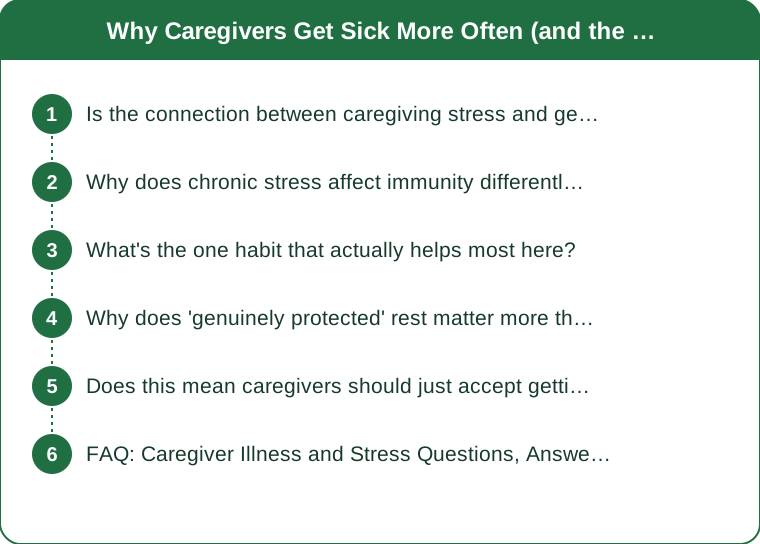
Is the connection between caregiving stress and getting sick more actually real?
Yes — this is one of the more well-documented findings in caregiver health research. Chronic stress elevates cortisol over sustained periods in a way that suppresses immune response, and studies specifically on long-term caregivers have found measurably higher rates of illness and slower wound healing compared to non-caregivers of similar age and health.
Why does chronic stress affect immunity differently than short-term stress?
Short bursts of stress can actually mobilize immune response temporarily. It’s the sustained, ongoing nature of caregiving stress — months or years without meaningful relief — that shifts this into a suppressive effect instead, since the body doesn’t get the recovery window it needs between stress events.
What’s the one habit that actually helps most here?
Protected, non-negotiable rest windows — even short ones — appear to matter disproportionately, based on caregiver health research, more than trying to eliminate the stress itself, which often isn’t fully possible. A genuinely protected 20-30 minutes daily, where you’re not on-call, gives the body’s stress response a chance to actually down-regulate.

Why does ‘genuinely protected’ rest matter more than just resting?
Because rest time you’re still mentally on-call for (listening for a call bell, checking your phone every few minutes) doesn’t produce the same physiological recovery as time where you’re actually, fully off duty. Arranging real backup — even briefly — for that window is what makes the difference, not just carving out the time on paper.
Does this mean caregivers should just accept getting sick more?
No — the point is that this is a real, addressable physiological pattern, not a personal failing or something to just push through. Respite care, even a few hours a week, and consistent sleep protection are both evidence-backed ways to meaningfully reduce this effect over time.
FAQ: Caregiver Illness and Stress Questions, Answered
How long does it take for protected rest to actually improve immune function?
Research doesn’t point to an exact universal timeline, but consistent protected rest over several weeks tends to show measurable improvement in caregiver studies, rather than a one-time break producing lasting change.
Is it worth mentioning this pattern to a doctor?
Yes — if you’re getting sick unusually often or recovering slowly, it’s worth raising specifically as caregiver-related stress with a healthcare provider rather than treating each illness as an isolated event.
Does this apply to short-term caregiving too, or only long-term?
The effect is most documented in sustained, long-term caregiving, but the underlying mechanism (chronic stress suppressing immune response) can begin showing effects well before the one-year mark for many caregivers.
TL;DR:
- Chronic caregiving stress measurably suppresses immune function, documented in caregiver health research
- It’s the sustained nature of the stress, not stress itself, that causes this effect
- Genuinely protected, non-negotiable rest windows help more than trying to eliminate the stress entirely
- This is a real physiological pattern worth mentioning to your own doctor, not a personal failing
This is general information, not medical advice — persistent or worsening illness patterns are worth discussing with a healthcare provider.
Keep Reading
This article is for general informational purposes only and is not medical advice. Always consult a qualified health professional for guidance specific to you.