Why Caregivers Crash by Mid-Afternoon (and the Hydration Piece Nobody Mentions)
Quick Answer: Caregivers frequently under-hydrate not from forgetting to drink, but from deliberately limiting fluids to avoid bathroom breaks during care tasks — that pattern compounds with stress and sleep disruption to produce a sharper afternoon crash than either factor alone would cause.
Sleep disruption and chronic stress get most of the blame for caregiver fatigue, and they’re real contributors — but a quieter, more fixable factor often goes unaddressed: many caregivers are mildly, chronically dehydrated by early afternoon without realizing it.

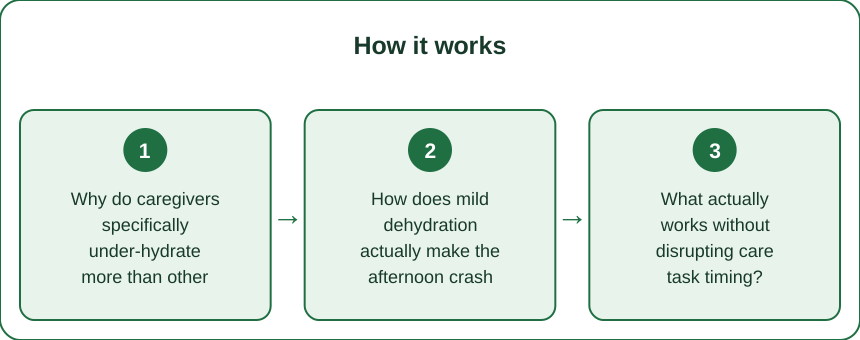
Why do caregivers specifically under-hydrate more than other busy people?
Unlike a typical office worker, caregivers often can’t step away for a bathroom break on their own schedule — care tasks (feeding, transfers, appointments) create real time windows where leaving isn’t practical, which leads many caregivers to unconsciously limit fluid intake specifically to avoid needing a break at an inconvenient moment.
This is a learned, protective habit that made sense in the moment but compounds daily into a consistent mild dehydration pattern most caregivers don’t consciously notice.
How does mild dehydration actually make the afternoon crash worse?
Mild dehydration produces fatigue, difficulty concentrating, and irritability that closely mimics general exhaustion, meaning it stacks directly on top of stress-related and sleep-related fatigue rather than being a separate, smaller issue — the combined effect is often sharper than either cause alone.
Because the symptoms overlap so closely with generic caregiver burnout, the hydration piece is easy to miss entirely, even though it’s one of the more directly fixable contributors.

What actually works without disrupting care task timing?
Front-loading fluid intake earlier in windows when a bathroom break is genuinely available (before a care task begins, rather than during) covers more total hydration without requiring breaks during inflexible stretches.
A marked water bottle with time-based goals (finished by specific points in the morning) also helps caregivers hit adequate intake without needing to actively track it during the busiest, most inflexible parts of the day.
Myth vs Fact: Caregiver Hydration
Myth: Feeling thirsty is a reliable signal to drink enough. Fact: thirst is a lagging indicator — by the time it’s noticeable, mild dehydration has often already started affecting energy and focus.
Myth: Coffee counts the same as water for hydration. Fact: coffee does contribute some fluid, but its mild diuretic effect means it shouldn’t be counted as a full substitute for plain water intake.
Myth: This is just an unavoidable part of caregiving. Fact: front-loading fluids during available windows is a genuinely practical fix that doesn’t require more flexible care task timing to implement.
FAQ: Caregiver Hydration Questions, Answered
How much water should a caregiver realistically aim for daily?
General guidance of roughly 8-10 cups daily is a reasonable baseline, though needs vary by body size and activity — the bigger practical fix for caregivers specifically is timing intake earlier, not necessarily drinking more overall.
Does this apply even if I don’t feel thirsty during the day?
Yes — the whole issue is that thirst often isn’t a reliable early signal, so a time-based intake habit works better than waiting to feel thirsty.
Could the afternoon crash be something other than hydration and stress?
Possibly — if the fatigue feels severe or doesn’t improve with better hydration and rest, it’s worth mentioning to a doctor, since caregiver burnout can also involve other physical factors worth ruling out. This is general information, not medical advice.
TL;DR:
- Caregivers often limit fluids specifically to avoid bathroom breaks during inflexible care windows
- That mild, chronic dehydration compounds with stress and sleep loss into a sharper afternoon crash
- Front-loading water intake during available windows fixes this without disrupting care task timing
- Thirst is a lagging signal — a time-based drinking habit works more reliably
The afternoon crash isn’t purely unavoidable caregiver exhaustion — part of it is a fixable hydration pattern hiding in plain sight. This is general information, not medical advice.
Keep Reading
This article is for general informational purposes only and is not medical advice. Always consult a qualified health professional for guidance specific to you.