The Guilt of Needing a Break From Caregiving — and Why It Doesn't Mean You're Failing
Quick Answer: Feeling guilty about needing a break from caregiving is extremely common and does not mean you’re failing or don’t care — sustainable caregiving actually requires regular rest, and burnout from refusing breaks tends to hurt the person you’re caring for more than the break itself ever would.
You finally get an hour to yourself, and instead of resting, you spend it feeling guilty for wanting the hour in the first place. If that sounds familiar, you’re far from alone.

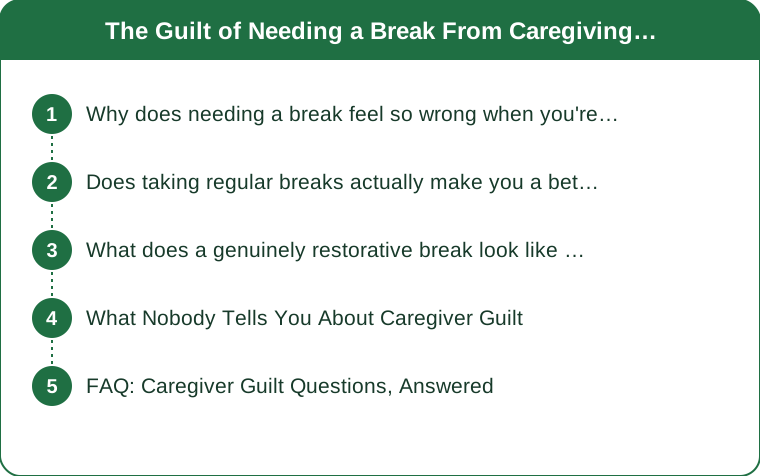
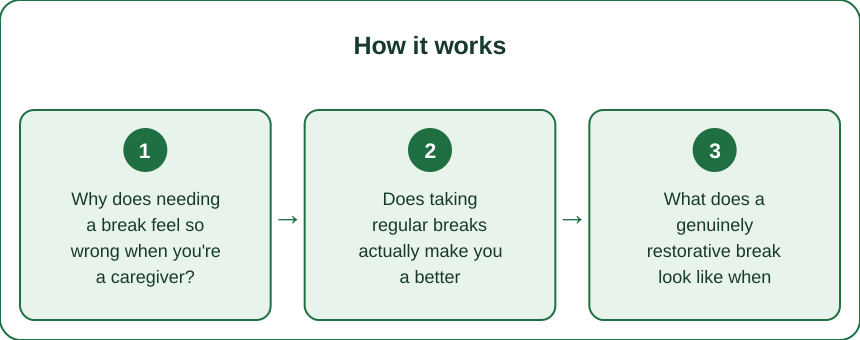
Why does needing a break feel so wrong when you’re a caregiver?
Caregiving often comes wrapped in identity and love, which makes rest feel like it’s competing with those feelings rather than supporting them. Many caregivers unconsciously equate “needing space” with “not caring enough,” even though the two have nothing to do with each other.
Does taking regular breaks actually make you a better caregiver, or just a more selfish one?
Regular breaks make you a measurably better caregiver, not a worse one. Caregiver burnout is strongly linked to increased impatience, reduced attentiveness, and even health problems in the caregiver themselves — all of which directly reduce the quality of care being provided. A rested caregiver has more actual capacity to give.

What does a genuinely restorative break look like when time is limited?
Even 15-20 minutes of true disengagement — not checking on them, not planning the next task — counts. The quality of disengagement matters more than the length; a fully present 20-minute break tends to restore more than a distracted 2-hour one where you’re still mentally on duty.
What Nobody Tells You About Caregiver Guilt
Here’s the part rarely said out loud: the guilt itself often isn’t really about the break — it’s about unprocessed grief, fear, or exhaustion that the break gives you space to actually feel. That’s uncomfortable, which is part of why some caregivers unconsciously avoid taking breaks in the first place — staying busy keeps those harder feelings at bay.
Recognizing this doesn’t make the guilt disappear instantly, but it does reframe it — the guilt isn’t evidence you’re doing something wrong by resting; it’s often evidence that you’ve been running on empty long enough that stopping, even briefly, brings everything else to the surface.
FAQ: Caregiver Guilt Questions, Answered
Is it normal to feel resentment toward the person you’re caring for sometimes?
Yes — resentment alongside love is an extremely common and normal caregiving experience, not a sign of being a bad caregiver, though persistent or intense resentment is worth discussing with a therapist or support group.
How do you actually get over the guilt of taking a break?
Most caregivers don’t “get over” it entirely so much as learn to take the break anyway, treating the guilty feeling as background noise rather than a stop sign — the guilt fading over time with practice is common but not universal.
Should you tell the person you’re caring for that you need a break?
When possible, yes — most care recipients would rather you take care of yourself than silently burn out, though how and when to communicate this depends heavily on their cognitive and emotional state.
TL;DR:
- Needing a break doesn’t mean you love or care less — it’s a near-universal caregiver experience
- Regular breaks measurably improve caregiving quality, not reduce it
- Even a fully present 15-20 minute break restores more than a distracted longer one
- The guilt is often about deeper unprocessed feelings surfacing, not evidence you’re doing something wrong
This is general information, not medical or psychological advice — a caregiver support group or therapist can help if the guilt or burnout feels unmanageable on your own.
Keep Reading
This article is for general informational purposes only and is not medical advice. Always consult a qualified health professional for guidance specific to you.