Why a Caregiver's Hands Ache at Night, and What Helps
Quick Answer: Caregiver hand pain that peaks at night usually comes from sustained low-level gripping rather than any single heavy lift - hours of holding, steadying, buttoning, and transferring. Tendons in the hand and forearm swell slightly with repetitive load, and swelling is worst when you finally stop moving. Two minutes of forearm and finger work in the evening, plus deliberately varying your grip during the day, helps most people within about two weeks.
Back pain gets all the caregiving attention. Hands are where a lot of people actually feel it first, and they tend to assume it is just age.

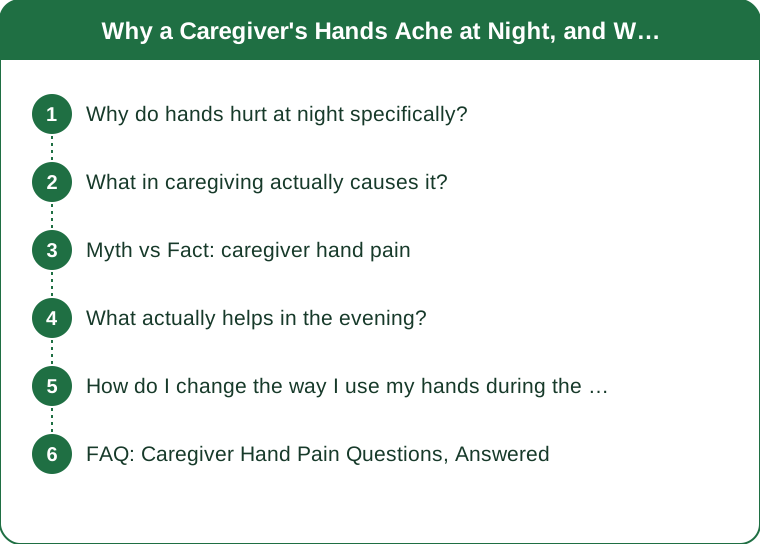
Why do hands hurt at night specifically?
Because the swelling that builds during the day has nowhere to go once you stop moving.
Repetitive gripping causes mild inflammation in the tendon sheaths of the fingers and forearm. During the day, muscle contraction acts as a pump that moves fluid along. When you finally sit down or lie down, that pumping stops, fluid pools, and pressure inside the carpal tunnel and finger sheaths rises.
Wrist position makes it worse. Most people sleep with their wrists flexed, which narrows the carpal tunnel further. That is why the classic pattern is waking at 2 or 3 a.m. with numb or aching fingers and shaking the hand to relieve it.
If that is your pattern, a neutral wrist splint worn at night is one of the highest-return interventions available - inexpensive, no side effects, and often noticeably better within a week or two.
What in caregiving actually causes it?
Not the obvious things. Ask most people and they say lifting. The load is usually elsewhere.
- Sustained gripping - holding a hand or arm steady for balance, sometimes for minutes at a time. Static grip is far more fatiguing than intermittent grip.
- Small fasteners - buttons, snaps, zippers, medication blister packs, pill bottle caps. Fine pinch grip loads the thumb base heavily.
- Wringing and twisting - washcloths, jar lids, bedding.
- Carrying by handle - bags, laundry baskets, water pitchers. A pinch-and-carry position held for 90 seconds is significant load.
- Pushing a wheelchair or walker with an extended wrist for long stretches.
The common thread is duration, not intensity. Ten minutes of light gripping is harder on tendons than one heavy lift, and caregiving is full of ten-minute grips.
Myth vs Fact: caregiver hand pain
Myth: It is arthritis and there is nothing to do. Fact: Overuse tendinopathy and nerve compression are far more common in this pattern, and both respond well to load management. Arthritis is a diagnosis a clinician makes, not one you should assume.
Myth: Resting completely is the answer. Fact: Total rest tends to make tendons less tolerant. Reduced and varied load usually beats no load.
Myth: Grip strengtheners will fix it. Fact: Squeezing a grip trainer adds more of the exact stimulus that caused the problem. The useful exercises are the opposite direction - finger extension and wrist mobility.
Myth: Night numbness is normal when you are tired. Fact: Numbness that wakes you regularly is worth mentioning to a doctor. It is common, but common is not the same as fine. This is general information, not medical advice.

What actually helps in the evening?
A short routine, done consistently, beats a long one done occasionally. This takes about two minutes.
Finger extensions with a rubber band. Loop a band around all five fingertips and open your hand against it. 2 sets of 15, slowly. This trains the extensors, which get almost no work in a day full of gripping.
Wrist flexor stretch. Arm straight out, palm up, gently pull the fingers back with the other hand. 30 seconds each side.
Forearm self-massage. Thumb pressure along the meaty part of the forearm below the elbow, both sides, 30 seconds each. This is where most of the finger tendons originate.
Nerve glides. Arm out to the side, palm up, gently tilt your head away while extending the wrist, then release. 5 slow repetitions. Should feel like a stretch, never a sharp zing - if it does, stop.
Do it while something is on television. The consistency matters far more than the precision.
How do I change the way I use my hands during the day?
Small substitutions, spread out, do more than any exercise.
Widen every handle you can. Foam tubing, pipe insulation, or purpose-made grips cost almost nothing and dramatically reduce the force required to hold something. Apply to utensils, toothbrushes, pens, and cleaning tools.
Carry with your forearm, not your fingers. Hook bags over your forearm or use a crossbody. Use a laundry basket with two hands underneath rather than one handle.
Use the whole hand instead of a pinch. Open jars with a grip pad rather than fingertips. Use a pill organizer filled once a week rather than fighting blister packs daily.
Alternate hands deliberately. Most people default to one hand for everything. Consciously switching for carrying and steadying halves the load on the dominant side.
Take 30-second breaks. When you are holding a position, release and shake out every couple of minutes. Static grip is the thing to interrupt.
These are unglamorous and they work. Most people report a meaningful difference in evening ache within about two weeks.
FAQ: Caregiver Hand Pain Questions, Answered
When should I see a doctor about this?
Numbness that wakes you regularly, weakness where you drop things, pain that persists more than 6 weeks despite changes, or any loss of sensation in specific fingers. Those are worth a clinician’s assessment. This is general information, not medical advice.
Do night splints actually work?
For wrist-position-related nighttime symptoms, they are one of the better-supported simple interventions. Get one that holds the wrist neutral rather than extended, and expect to need a week or two to adjust to sleeping in it.
Should I use heat or ice?
Most people find warmth more helpful for the stiff aching pattern, particularly a warm soak in the evening before the stretches. Ice tends to help more with a sharp, recently aggravated area.
TL;DR:
- Evening and night hand pain comes from hours of sustained light gripping, not from single heavy lifts.
- Pain peaks at night because the muscle pump stops and fluid pools, worsened by a flexed sleeping wrist.
- Skip grip strengtheners. Train finger extension, wrist mobility, and forearm release instead.
- Widen handles, carry on your forearm, alternate hands, and break static grips every couple of minutes.
- A neutral night splint is cheap and often the single most effective change.
- Numbness that wakes you, or weakness where you drop things, is a doctor conversation.
Caregiving asks a lot of a pair of hands that nobody trained for it. Two minutes in the evening and a few widened handles is a genuinely small price for getting your nights back. This is general information, not medical advice.
Keep Reading
This article is for general informational purposes only and is not medical advice. Always consult a qualified health professional for guidance specific to you.