Why Caregivers Feel Mentally Exhausted by Evening Even on 'Easy' Days
Quick Answer: Physically light caregiving days can still be mentally exhausting because of decision fatigue — the accumulated cost of dozens of small judgment calls (medication timing, mood monitoring, meal decisions) made throughout the day, which drains mental energy in a way that doesn’t show up as physical tiredness.
It’s confusing to feel wiped out after a day that, on paper, wasn’t physically demanding — but the mental load of constant small decisions adds up in a way physical effort doesn’t.

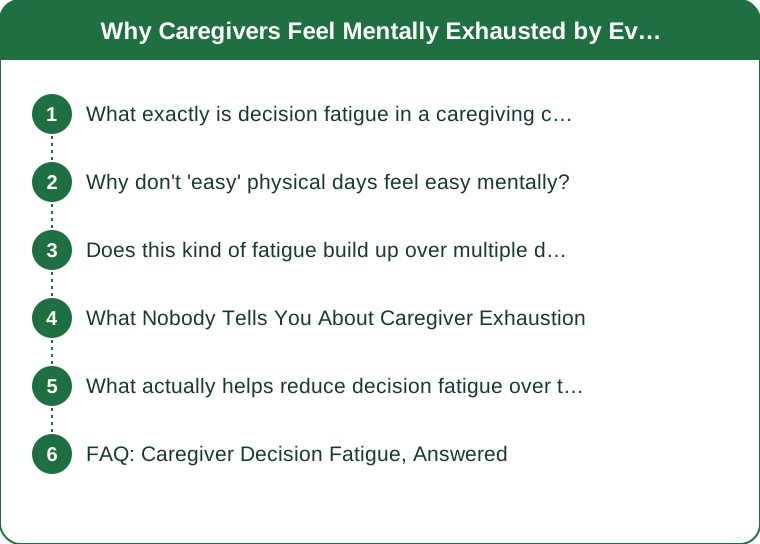
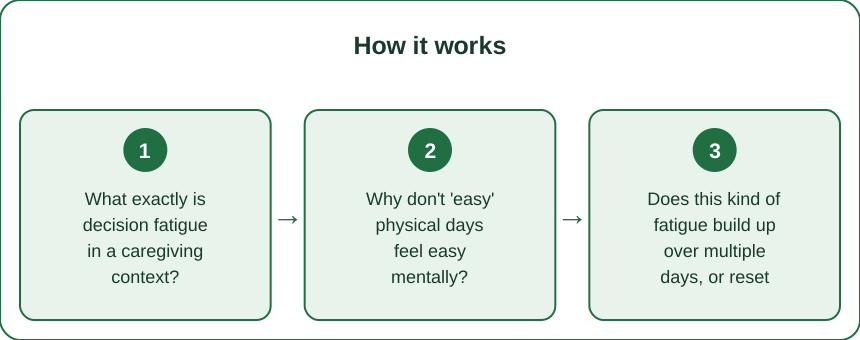
What exactly is decision fatigue in a caregiving context?
Decision fatigue is the measurable decline in judgment quality and mental energy that comes from making many decisions in a row, and caregiving involves dozens of small ones daily — is this symptom normal, is it time for medication, is this mood shift concerning. Each one is small, but they compound over a full day.
Why don’t ‘easy’ physical days feel easy mentally?
A day with minimal physical tasks can still involve the exact same number of vigilance-based decisions as a demanding one, since the mental monitoring (checking in, assessing, deciding whether something needs attention) doesn’t scale down just because the physical to-do list is shorter.
Does this kind of fatigue build up over multiple days, or reset each night?
For many caregivers it accumulates rather than fully resetting overnight, especially without dedicated mental rest, which is part of why caregiver burnout tends to build gradually rather than appearing suddenly on one hard day.

What Nobody Tells You About Caregiver Exhaustion
Nobody tells you that the exhaustion from an ‘easy’ day can sometimes feel worse than a physically hard one, because there’s no obvious explanation for it — which often leads caregivers to feel like they’re overreacting to something that ‘shouldn’t’ be tiring. Naming it as decision fatigue, rather than unexplained tiredness, tends to reduce that self-doubt.
What actually helps reduce decision fatigue over time?
Reducing the number of daily decisions where possible — set medication times, a repeating simple meal rotation, pre-planned responses to common situations — frees up mental capacity for the decisions that genuinely need fresh judgment. This isn’t about doing less caregiving, just removing unnecessary repeated decision-making.
FAQ: Caregiver Decision Fatigue, Answered
Is decision fatigue a sign something is wrong with how I’m caregiving?
No — it’s a normal, well-documented response to sustained decision-making, not a sign of doing anything incorrectly.
Does decision fatigue affect physical health too, not just mood?
Yes, chronic decision fatigue is linked to disrupted sleep and increased stress hormone levels over time, which is part of why addressing it matters beyond just feeling tired.
Can short breaks during the day actually help with this?
Yes, even short breaks (5-10 minutes without needing to monitor or decide anything) give the mind a genuine reset that accumulates meaningfully over a full day.
TL;DR:
- Mental exhaustion on physically light caregiving days is often decision fatigue, not laziness or overreaction
- Dozens of small daily judgment calls compound even when the physical task list is short
- This fatigue can accumulate across days rather than fully resetting overnight
- Reducing unnecessary repeated decisions (set routines, pre-planned responses) frees up mental capacity
The tiredness is real even when the day looks easy on paper — recognizing decision fatigue for what it is makes it easier to plan real recovery instead of just pushing through.
Keep Reading
This article is for general informational purposes only and is not medical advice. Always consult a qualified health professional for guidance specific to you.